
You know your fleet needs visibility. But the moment you start pricing GPS tracking solutions; the hardware math hits hard. A decent cellular tracker costs $150 to $500 per vehicle. Multiply that by 50 trucks, and you’re looking at $7,500 to $25,000 in upfront equipment costs before installation labor, before set up, before your first month of service.
Then there’s the installation friction. Each vehicle needs to come into the shop for 1-3 hours. Wiring under the dash, running power, configuring the device while your truck sits idle and doesn’t generate revenue. And when the device fails in year three, you’re buying another one and paying installation again.
RastracFusion eliminates this entire problem. Instead of buying hardware, you leverage the telematics system already built into your vehicles by the manufacturer. Connect directly to that existing infrastructure with Rastrac’s platform, and you’re tracking within one business day with zero hardware costs and zero vehicle downtime.
RastracFusion is a hardware-free GPS tracking solution that connects directly to your vehicle’s factory-embedded telematics system. Instead of installing a third-party GPS device under the dash, Rastrac accesses the OEM (original equipment manufacturer) telematics already present in 97% of North American vehicles: Ford, GM, Stellantis (Chrysler/Dodge/Jeep/Ram), Tesla, Toyota, Volvo, Mack, Hino, and more.
The key difference: Rastrac’s team handles the onboarding. You provide vehicle VINs, proof of ownership, and consent. Rastrac connects your vehicles to the OEM telematics platform in the background. The vehicles are typically live and reporting within one business day. No technician visits. No under-dash wiring. No vehicle downtime.
The telematics data flows directly from the vehicle to Rastrac’s cloud platform, the same powerful software you’d use if you installed hardware devices. You get the same real-time tracking, the same alerts, the same reports, and the same cost savings, but without owning or maintaining a single piece of hardware.
RastracFusion taps into over 150 vehicle data points your manufacturer already collects: GPS location, speed, fuel level, battery health, tire pressure, engine diagnostics, coolant temperature, fuel consumption, odometer readings, and diagnostic trouble codes. The data is OEM-validated, meaning it comes straight from the vehicle’s engine control unit, not a third-party guess.
This matters because accurate data drives better decisions. You don’t estimate maintenance intervals; engine diagnostics tell you exactly when service is needed. You don’t guess at fuel efficiency; real consumption data identifies efficiency problems before they cost you thousands in wasted fuel.
The traditional GPS tracking process involves three friction points: cost, installation, and maintenance. RastracFusion removes all three.
Hardware-based GPS tracking starts with a device purchase. A cellular tracker runs $150-500 per vehicle. An OBD-II plug-in device is cheaper but still costs money and takes up the diagnostic port. Solar-powered trackers for equipment run $200-400 upfront plus monthly subscriptions.
RastracFusion eliminates the hardware line item entirely. You subscribe to the service. That’s it. No device purchase. No installation hardware cost. No replacement costs when a device fails. For a 50-vehicle fleet, eliminating $200 per-vehicle hardware costs saves $10,000 on day one.
Traditional hardware installation requires scheduling each vehicle into the shop for 1-3 hours. The technician runs power wires, mounts the device, configures settings, and tests the connection. During that time, the vehicle generates zero revenue.
For a small fleet of 10 trucks, that’s 10-30 hours of lost productivity. For a fleet of 100, you’re looking at 100-300 hours, equivalent to 2-7 weeks of vehicle downtime spread across the year.
RastracFusion requires zero installation appointments. Rastrac’s team handles the backend setup after you provide VINs and consent. Your vehicles stay in service the entire time.
Once Rastrac completes the onboarding process, which typically takes one business day after you submit vehicle information, your fleet is live and tracking. Compare that to hardware installation timelines:
This speed advantage matters for fleets with urgent tracking needs. If you’re launching a new service area or addressing a theft problem, RastracFusion gets you visibility within days, not weeks.
Removing hardware costs is just the opening. The real savings come from what Rastrac’s software does with the data and those benefits flow faster because you’re not waiting for hardware installation.
Rastrac tracks real fuel consumption from your vehicles’ onboard systems. This data reveals which drivers are idling excessively, which routes are inefficient, and which vehicles have fuel issues. Fleets typically reduce fuel costs 15-30% within the first three months of implementation.
For a fleet of 20 trucks averaging $5,000 in annual fuel cost per vehicle, that’s $100,000 total fuel spend. A 20% reduction saves $20,000 yearly, recovering your Rastrac investment within 2-3 months.
Rastrac monitors engine diagnostics in real time. Instead of changing oil on a calendar schedule (servicing some vehicles too early, running others past their service intervals), maintenance is triggered by actual engine hours and vehicle condition.
This precision scheduling reduces unexpected breakdowns by 40-50% and extends vehicle lifespan by 25% or more. For a fleet with $500,000 in total vehicle value, extending vehicle life by 25% equals $125,000 in preserved asset value.
Geofencing creates a virtual boundary around job sites, parking lots, or service areas. The moment a vehicle crosses that boundary when it shouldn’t, after hours, overnight, or outside the approved territory, you receive an instant alert. GPS-tracked vehicles see 80% reduction in unauthorized use.
For equipment rental companies, this prevents customers from taking rented equipment beyond agreed territories. For construction firms, it stops after-hours equipment theft. For service fleets, it prevents operators from running side jobs with company vehicles.
Not all your vehicles may be compatible with RastracFusion immediately, and some may not be worth connecting. A 1995 dump truck doesn’t have OEM telematics. A trailer or generator has no embedded system at all.
Rastrac’s solution: manage both Fusion-connected and hardware-tracked vehicles on the same platform.
You can have:
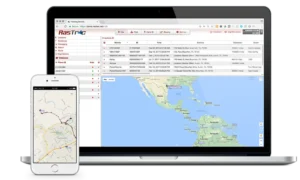
This flexibility means you’re not forced into an all-or-nothing decision. Migrate to RastracFusion as your fleet ages into compatible vehicles. Keep hardware devices on older assets. Add solar trackers to equipment. Everything reports to the same Rastrac platform, the same mobile app, the same reporting system.
Q: How does Rastrac access my vehicle’s telematics without installing hardware?
A: Rastrac connects through the OEM (original equipment manufacturer) embedded telematics system already present in modern vehicles. The vehicle is essentially a computer, it collects data about location, fuel, temperature, diagnostics, and more. Rastrac’s team uses the vehicle’s VIN to establish a secure connection to that data stream via the manufacturer’s API. No physical device required.
Q: What if my vehicle isn’t compatible with RastracFusion?
A: If your vehicle lacks OEM embedded telematics, Rastrac offers traditional GPS tracking devices (ST4215, PT10, and others) that integrate seamlessly with the same platform. You manage both Fusion-connected vehicles and hardware-tracked assets from one interface.
Q: How long does setup take?
A: Typically, one business day after you provide vehicle VINs, proof of ownership, and consent. Rastrac’s team handles the backend activation. Your vehicles are live and reporting without any installation appointments or downtime.
Q: What vehicles does RastracFusion support?
A: 97% of North American connected vehicles, including Ford, GM (Chevrolet, Buick, Cadillac, Hummer), Stellantis (Chrysler, Dodge, Jeep, Ram, Fiat, Alfa Romeo), Tesla, Toyota, Volvo, Mack, and Hino. Coverage expands as new models are released and manufacturers enable connectivity.
Q: Can I track non-motorized assets like trailers or watercraft?
A: RastracFusion handles connected vehicles. For trailers, containers, jet skis, pontoon boats, ski boats, wakeboard boats, and other non-motorized or non-connected equipment, Rastrac offers solar-powered trackers (BeSol+) and hardwired devices that report to the same platform. A single dashboard shows everything.
Q: What if I have a mixed fleet—some new vehicles, some older trucks, some equipment?
A: Rastrac is designed exactly for this. Manage new Ford trucks via RastracFusion, older Chevy work vehicles with a cellular device, and all your trailers with solar trackers – all on the same platform. You don’t need separate software or dashboards.
The hardware requirement has held GPS tracking back for 20 years. Device costs, installation downtime, replacement cycles, and maintenance overhead made fleet tracking accessible only to large enterprises that could absorb these friction costs.
RastracFusion changes that calculus. You get enterprise-grade GPS tracking without enterprise hardware complexity. One business day to deployment. Zero vehicle downtime. Zero ongoing hardware maintenance. Same powerful analytics. Same proven 30+ year-old platform.
Your vehicles already have factory telematics. You’re already paying for that capability. RastracFusion simply unlocks it and connects it to the software that turns that data into fuel savings, maintenance optimization, and asset protection.